This year’s Banned Books Week began on Sunday, October 4 and will run through October 10. For the past several years, I’ve discussed the problem of book bans and recognized the individuals and organizations standing up for the freedom to read. You can read those posts here and here. In the past few years, advocates for the freedom to read have passed legislation to protect this right in California, Colorado, Connecticut, Delaware, Illinois, Maryland, Massachusetts, Minnesota, New Jersey, Rhode Island, Vermont, and Washington. A freedom to read bill in New York State passed the legislature in 2025 but was vetoed by the governor; a revised bill passed this year and is awaiting the governor’s signature. If you’re in New York State, the bill is S8630C and the contact information for Governor Hochul’s office is here.
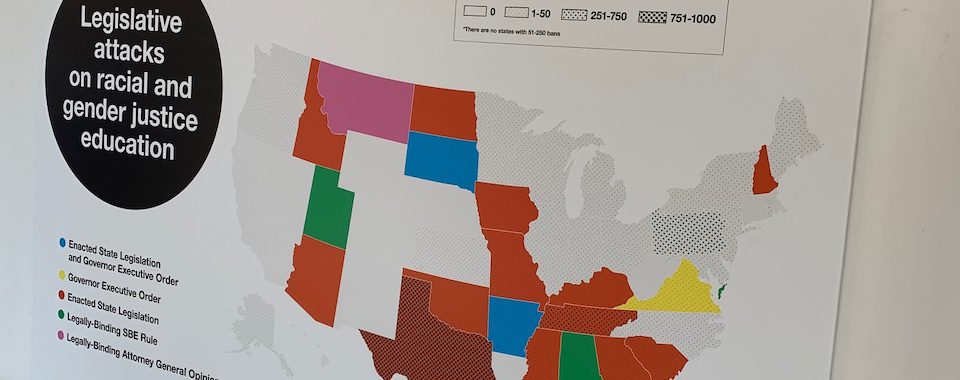
Too many states, however, are moving in the other direction, banning ever more books in schools and public libraries. According to PEN America, Texas is the worst offender, with Florida in second place. Overall, in 2025-26, nearly 12,000 books and 8,000 unique titles have been banned, with an increasing number of classics — the kinds of books I read in English class in Texas in the 1970s — removed from schools and libraries. Not satisfied with taking away access to books from all the children and teens in their states, leaders from the book banning states now want to take away access to books from all the children of the entire country through nationwide book bans. The House of Representatives has already passed two book bans targeting books with LGBTQ+ content, H.R. 7661 and H.R. 2616, that are awaiting action from the Senate, and is now working on H.R. 8705, which seeks to deny federal funding to school districts that teach “divisive concepts” — that is, views that challenge the current regime on race relations, gender, immigration, civil rights and civil liberties, corporate power, and systemic inequality. Fortunately, Congress is out of session, thanks to the upcoming midterm election campaigns and the Speaker’s early dismissal of the House to avoid voting on a resolution to impeach Secretary of Defense Pete Hegseth.
The PEN America report points out another new development, one that’s in large part responsible for the increase in unique titles being banned. Previously, book banners organized nationally and distributed lists of books to challenge, meaning that once a book had been banned in a single school district, word spread all over the country to pull the book. Only one person had to read a book, or lift quotes out of context from said book, for everyone else to challenge it. Now, no one is reading the books because the book banners are using AI to hunt for keywords, just like companies use AI to hunt for keywords in job seekers’ resumes rather than actually reading applications. In addition, AI picks up all the news of book bans, so potential book banners now don’t have to join an organization or talk to their like-minded neighbors. They can talk to ChatGPT instead and then get ChatGPT or another AI source to fill out the forms on their behalf. For book banners, therefore, literacy is neither required nor desirable.
The past months have seen a groundswell of opposition to AI for threatening jobs and potentially killing all of humanity. Local activists, including many who would consider themselves part of the MAGA movement, have turned against the construction of data centers that provide no additional jobs while causing water shortages and driving up utility costs. I would suggest to these people that if they’re worried about AI taking their jobs and ruining the quality of their lives, maybe they shouldn’t use it and instead do their own thinking. (For instance, I always turn off the AI editor when writing my blog posts and have blocked Copilot from my Microsoft programs.) Maybe do your own research by reading the books you want to ban, cover to cover.
The increase in book bans has taken place alongside a nationwide decline in reading that preceded the Covid-19 pandemic but accelerated after the lockdowns ended. Among adults, there was a bump in book sales during the time public venues were closed and people were at home with nothing to do, but for young people the pandemic’s disruptions and learning loss negatively affected their reading stamina and comprehension. Hence the trend toward shorter books, verse novels, and graphic novels. One wonders why books are the target when fewer young people are reading for pleasure anyway. Why not movies, video games, and social media, which occupy far more time and, in the case of social media, have documented negative effects?
A thousand years ago, most people didn’t know how to read. They obeyed rulers and priests because they didn’t know anything else. The Enlightenment, with its emphasis on reason, science and innovation, and the rights of all people, followed the invention of the printing press in the fifteenth century and the democratization of literacy. If you could read a book, you weren’t dependent on one ruler or priest for all your information because you could learn from anyone, anywhere in the world.
A reclaiming of reading — and the freedom to read — is an act of resistance. So is going to the original source for research rather than relying on AI, and creating our own work rather than letting AI do it for us. At a time when a handful of people want to control everyone else and take everyone else’s wealth and resources for themselves, reading, creating, and talking with others about what we’ve read and created is the ultimate assertion of our dignity and humanity.