
On July 26, 1990, the Americans with Disabilities Act (ADA) became law. It was based on two principles — accessibility and nondiscrimination. The first principle demanded that public facilities and telecommunications be accessible to people with disabilities. The second principle protected people with disabilities from discrimination in employment and access. A second law that went into effect in 1990, the Individuals with Disabilities in Education Act (IDEA), ensured access, accommodation, and nondiscrimination in both public and private education, and stipulated that disabled students attend classes in the least restrictive environment. This meant that more students would attend classes alongside their nondisabled peers, perhaps with an aide or other accommodations such as more time to take tests.
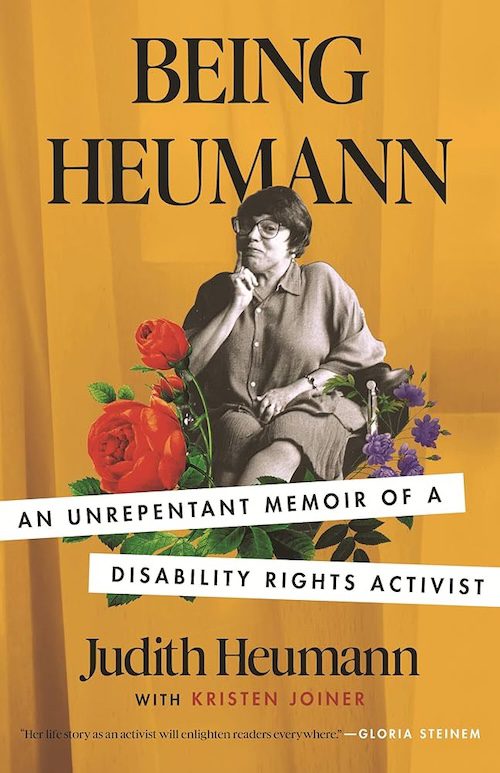
The passage of ADA and IDEA followed decades of activism. Pioneers such as Judith Heumann, who used a wheelchair after contracting polio when she was 18 months old, fought for the rights of disabled people to attend school and work in their chosen professions. Years after Heumann’s mother fought for her daughter’s right to an education, Heumann herself won a battle against the New York State Department of Education and the New York City Board of Education to teach in the same self-contained special education classroom where she had been a student. Heumann would go on to be a leading advocate for access, accommodation, and nondiscrimination, which included a 28-day sit-in at the Federal building in San Francisco in 1977 to force the government to implement ADA and IDEA’s precursor, Section 504 of the Rehabilitation Act, which had been passed by Congress four years earlier. The ADA gained momentum in the 1980s as a result of the HIV/AIDS epidemic and the efforts of LGBTQ+ activists to be heard by media and a government that had alternately ignored and vilified them. Throughout these decades, disabled activists worked alongside other civil rights activists to make their voices heard. Disability is something that affects everyone regardless of race, ethnicity, religion, sexual orientation, and gender identity, and abled people will in all likelihood become disabled as they age.

One would think that the 35th anniversary of ADA would be a celebratory affair, but this year it isn’t. The regime’s banning of DEI (Diversity, Equity, and Inclusion) is actually a DEIA ban, with Accessibility for the disabled targeted. The recent budget bill, which the regime titled the One Big Beautiful Bill, but should be called the One Big Ugly Bill, cuts billions of dollars from Medicaid, a lifeline for disabled people, in order to give tax cuts to the ultra-wealthy. I doubt any of those ultra-wealthy are going to step in to help anyone now buried in medical bills; rather, people with medical needs will have to increase their GoFundMe pleas to raise money from their neighbors who also have next to nothing. Federal workers with disabilities have already been blamed for everything from the deadly mid-air collision over Washington, DC in January to our country’s supposed lack of military readiness. This scapegoating does not bode well for the enforcement of anti-discrimination measures that are part of ADA. Furthermore, attacks by Health and Human Services Secretary Robert F. Kennedy, Jr, on people who are autistic, mentally ill, or have chronic illnesses, and threats to incarcerate these people in “wellness camps,” harkens back to the eugenics policies of the Nazi regime. Bhrea Koneman’s eloquent essay “Microphone of Malice” is essential reading on that topic, as she writes:
The Holocaust did not begin with gas chambers. It began with language and ideologies. It began with the slow, normalization of dehumanization. It began with misinformation and propaganda. It began with political leaders and public figures planting the idea that certain lives were less valuable—less productive, less worthy, less human.
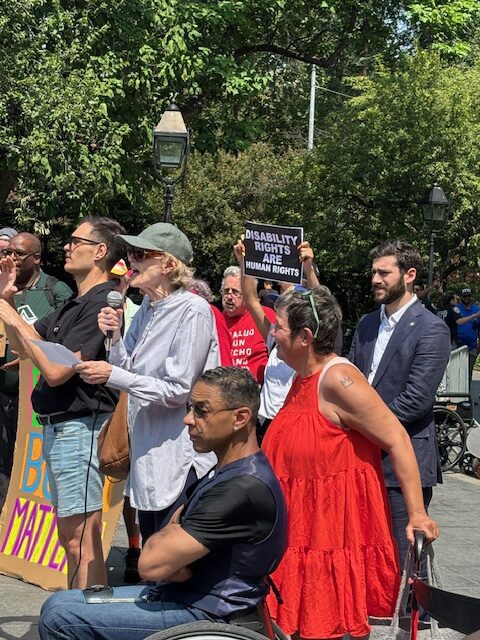
The speakers at the ADA35 rally were aware of the regime’s plans. One speaker has already made other arrangements; just before the inauguration, she moved to Iceland to attend university. The acclaimed author Siri Hustvedt, who has written about her neurological disorder, connected today’s regime with the eugenics movement in the United States in the 1920s that inspired Hitler and said:
We have seen it before. A hundred years ago after a global pandemic killed 50 million people around the world, fascist and eugenic movements rose in the U.S. and elsewhere. Mussolini had been in power for three years. Falling birth rates were causing nativist panic here and in many other countries. In the U.S. white Protestants feared being replaced by their supposed genetic inferiors, immigrant “hordes” from Eastern and Southern Europe, Mexico, and South America that would pollute the national blood….Number 47 yammers on good, bad, and criminal genes, IQ, breeding, and “born that way.”…The cruelty is not incidental. Sadism is elemental to fascist eugenics…
 Hustvedt encouraged the rally attendees to stand up and tell their stories. I thought about telling the stories of people with disabilities who have achieved great things — for instance, a quadriplegic man I work with who is a successful inventor — but we shouldn’t have to justify our existence to people who wish to harm us. Human rights, as well as the rights that are granted in the U.S. Constitution, belong to us because of who we are — that is, human beings — and not because of what we have accomplished or are expected to accomplish. That said, telling our stories means we have a voice, we have agency, and we can tell our stories rather than relying on others to tell them for us.