
I’d like to begin by welcoming my new readers to the blog. And since many of these new readers have clicked on posts related to the craft of writing, I will add a new one that’s especially relevant: the inciting incident.
The inciting incident in a novel is the event that forever changes the protagonist’s ordinary world. It does so by setting off a chain of consequences. In the traditional Hero’s Journey identified by scholar Joseph Campbell, this event forces the protagonist to take the journey, though the initial reluctance to do so is often part of the Hero’s Journey structure. Whether or not it’s a journey, the inciting incident forces the character to react at the same time as it draws other characters into the story — characters that may threaten the protagonist or or else build alliances with the protagonist that lead to further action. For instance, in my novel Torch, the inciting incident is 17-year-old student Pavol’s self-immolation in Prague to protest the Soviet invasion of Czechoslovakia in 1968 and the Czech and Slovak people’s passivity in the months that followed. As a result of his fatal act of resistance, the political police target the three teenagers who considered Pavol their best friend, even though none of the three are friends with each other. Their reaction to the inciting event and its consequences for their lives involves their effort to find, trust, and work with each other in order to avoid losing everything they cherish. (Look for a future post on the importance of stakes in fiction.)
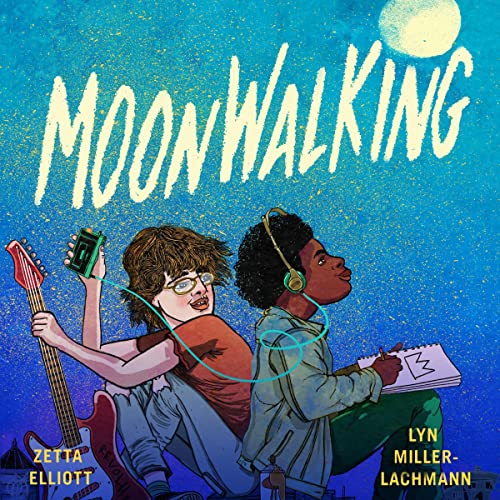
When I first took fiction classes through the New York State Summer Writers Institute, my workshop leader described the inciting incident as “someone arrives or someone leaves.” In Torch, Pavol leaves in a consequential way, but not in the consequential way he imagined. (Like the real resister Jan Palach, in whose footsteps he followed, Pavol believed his act by someone with his whole life ahead of him would spark an uprising for the freedom of his country.) This is more typical of literary or character-driven fiction where the protagonist’s relationships with other characters are key. Sometimes the protagonist is the one who arrives or leaves. This is common with romance or friendship stories with dual points of view, as in my co-authored novel Moonwalking where JJ moves to the place where Pie has lived all his life and they become unlikely friends for a season. Even so, a whole range of inciting incidents can bring future best friends or romantic partners together, from an auction for a play to the evacuation of the planet on a generation ship hours before a cataclysmic asteroid strike.
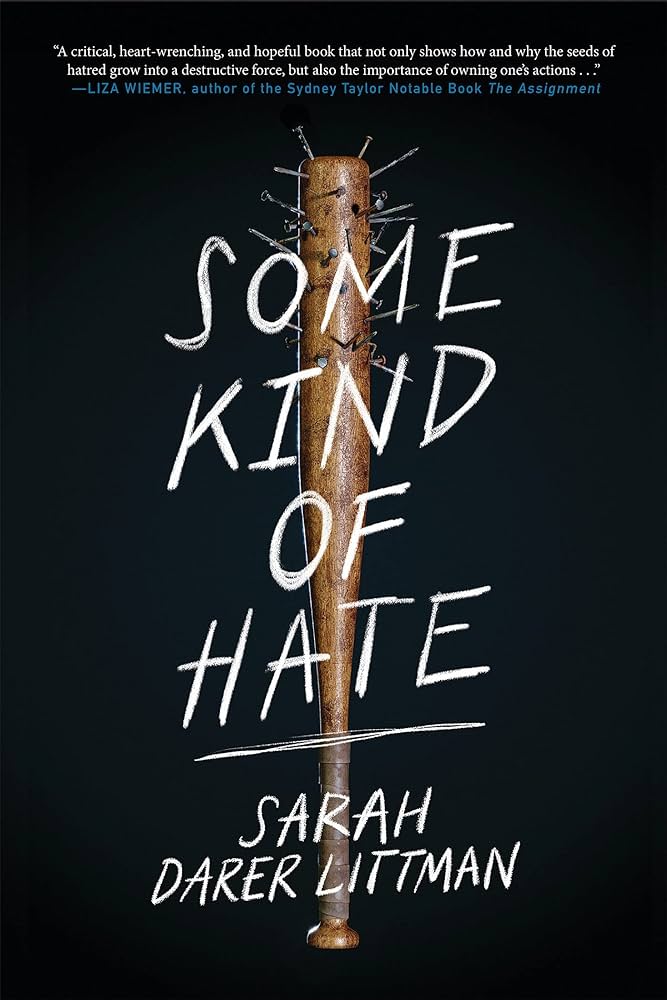 In the case of a mystery, the inciting incident is a murder or other crime. Other types of inciting incidents are natural or man-made disasters, or a major change in the protagonist’s circumstances. Maybe the protagonist loses an economic or social position, or is publicly humiliated. My friend Laurie Morrison used this inciting incident in her upper middle grade novel Coming Up Short, as Bea’s lawyer father has been indicted for misusing his client’s funds. In books with protagonists who are athletes, an injury is often the inciting incident, one that Sarah Darer Littman employs in Some Kind of Hate when the star pitcher is drawn into an extremist group after a climbing accident permanently wrecks his throwing arm. The key is that the inciting incident has consequences that irrevocably change the protagonist’s world.
Knowing this, you may be tempted to put the inciting incident on the first page. In general, though, this event needs to happen after you’ve introduced the main character(s) and the ordinary world. The sweet spot for novels, in general, is the end of the first chapter, though it could be as early as the first page and as late as ten percent of the way into the book. My initial draft of Torch had the inciting incident within the first eight pages, but my beta readers suggested moving it back to what ended up being page 15. I added a scene with Pavol, Štepán, and Tomáš writing a letter to the country’s rulers the week before Pavol and Štepán’s fateful trip to Prague. The new scene shows the hostile relationship between Štepán and Tomáš, as well as Pavol’s awareness that he’s asked too much of the terrified Tomáš and already suspects that his last-ditch effort to save both his country’s future and his own will fail.
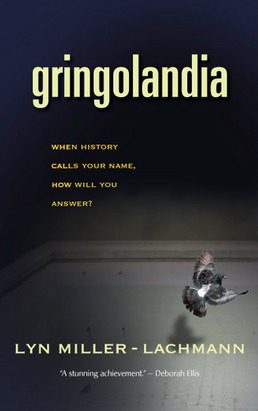 An inciting incident that comes too early threatens to confuse the reader about the characters, world, and stakes because it doesn’t show what the protagonist already has and values. When big events happen too soon, readers may ask themselves “why should we care about this character?” because they don’t really know the character. It was a risk I took when I put the inciting incident on the first page of Gringolandia, when soldiers break into 12-year-old Daniel’s apartment to arrest his father in Chile under the Pinochet dictatorship. As a result of beta reader comments, I had Daniel get out of bed to protect his mother from what he believes are robbers, knowing that his father, a taxi driver, is not home and he’s at that point the man of the house. His effort to help his mother, while brave, leads to disaster when soldiers overpower him and threaten to kill him unless his mother reveals her husband’s location.
On the other hand, an inciting incident that comes too late will likely bore the reader, who will put the book down and do (or read) something else. This is most often a problem with speculative or historical fiction, in which the writer wants to establish the world and the rules of that world before getting the story underway. If you’re writing a story set in an unfamiliar place and time, ask yourself: “Is all this information necessary now, or can I weave it into the story later?” and “Is this information necessary at all?” In general, readers retain more of a sense of the world if they see the characters interacting with the world, woven into the action, and not presented as exposition right at the beginning. Keep in mind, though, that the inciting incident isn’t the same thing as the hook. Many writers will put a scene from the middle of the book, or a prologue scene, at the beginning to pique readers’ curiosity and draw them into the story. This out-of-time-sequence approach (which I am trying in a current work-in-progress) does not absolve the writer from creating a timely inciting incident that upends the protagonist’s world and starts the chain of reaction, decisions, and actions.
As you start writing your own novel, especially if you’re just starting out, I suggest reading other published novels in your genre and identify the inciting incident, its impact on your protagonist’s world, and how your protagonist reacts to this event. And please feel free to comment or ask questions!



Dearest Lyn,
It’s been extraordinary to know you for over 25 years.
You are an amazing human being and an inspiration to me and our world!!!!
You keep coming up in my mind lately and I’d love to talk soon and get caught up with each other’s lives. I continue to work on “Free Spirits Crossing America” and “Beyond Memoir: Stories of My Life.” It’s time to finish them!
I look forward to talking to you!
Love,
Kathryn
Thank you, Kathryn! I hope this piece inspires you to finish the two manuscripts!