A year and a half ago, I wrote a blog post about my creative crisis as a writer of historical fiction. I had written three novels (not including a sequel to one) about teens living under dictatorships. I saw Gringolandia, Torch, and Eyes Open as warnings of what could happen if we, in taking our freedoms for granted, refused to see or to stand up against those of ill will seeking to impose a dictatorship in our own land. In accepting the Los Angeles Times Book Prize for Young Adult Literature for Torch in 2023, I received loud applause for my shout-out to the individuals and organizations advocating for the freedom to read. I mentioned how my young characters in Torch watched helplessly as the books, newspapers, and music they loved disappeared after the Soviet invasion of Czechoslovakia. But we still had the chance to stop the authoritarians.
Since then, the Los Angeles Times has itself bent the knee. Beloved TV programs such as The Late Show with Stephen Colbert and 60 Minutes are gone or turned into regime mouthpieces. BIPOC and LGBTQ+ authors have reported cancelled school visits, reduced sales, and editors unwilling to buy new books. We’re not yet Chile under Pinochet, the Soviet Bloc, Portugal under Salazar, or even Russia today. But speaking out and being different are much harder today than in 2023. And books that served as a warning only a few years ago feel more like a manual for survival today. Or not even survival, but the hope that a new generation will carry on one’s work and legacy. In other words, what happens when evil wins?
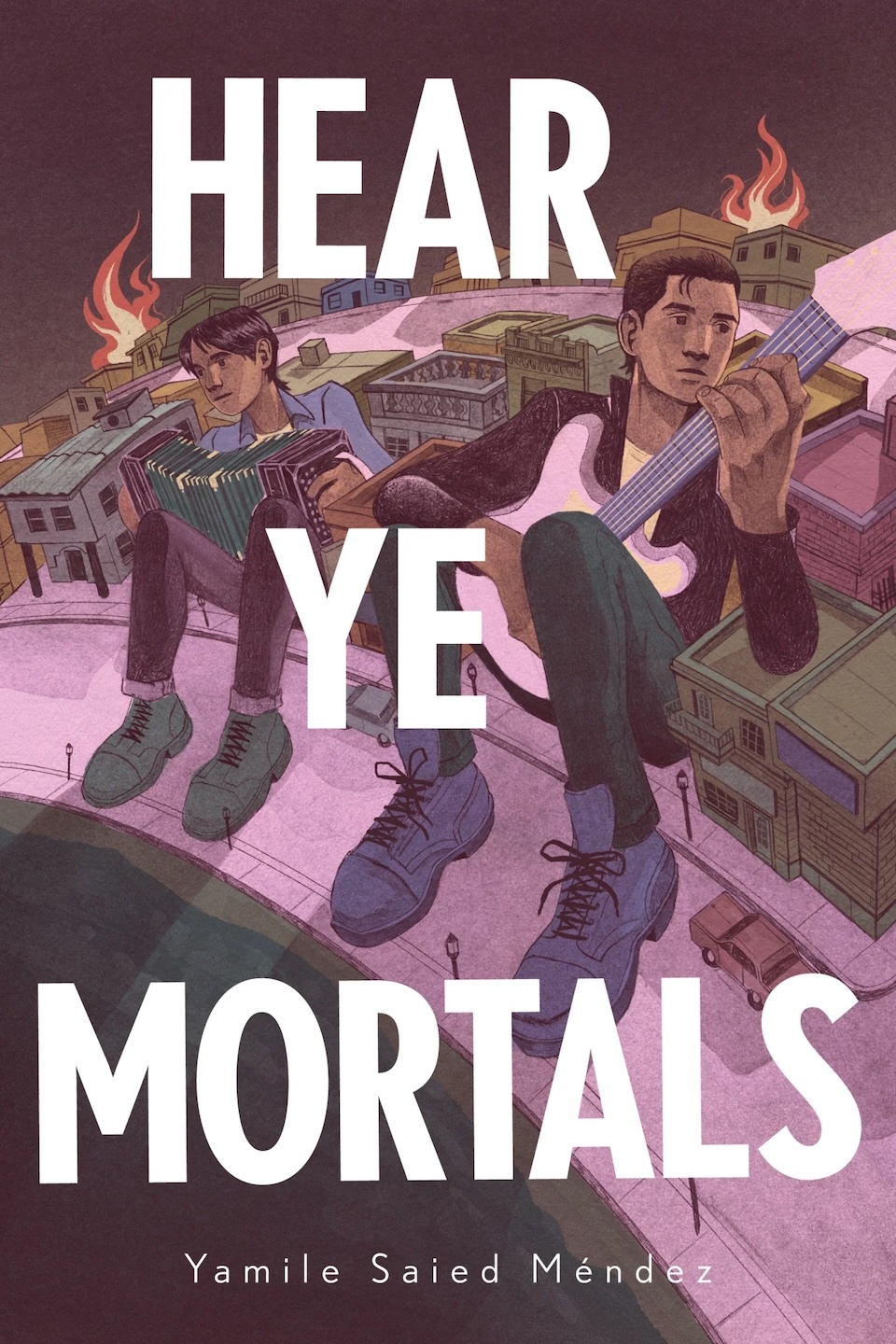 That’s the world that award-winning author Yamile Saied Méndez (Furia) explores in her new historical novel Hear Ye Mortals, published this month by Levine Querido. I reviewed the book for #WorldKidLit Wednesday, but wanted to say more about it than the limited space and scope of the review allowed me.
The title comes from the national anthem of Argentina, where the author grew up, and the book is set in 1976, at the time of a military coup that led to the seven-year Dirty War. During the Dirty War, more than 30,000 Argentinians, mostly young leftists but also labor leaders, educators, and artists, were arrested and then disappeared — their bodies never found. Thousands more were executed. Pregnant women were kept alive long enough to deliver their babies, who were then given or sold to right-wing families. The teenage members of the band Río Babel don’t want trouble — they only want a better life for themselves and their families in the midst of an economic crisis — but misinterpreted song lyrics make them both famous and a target for the military regime.
The novel is narrated by an angel who guides other young women, victims of violent men, to the afterlife. The dead teenager she encounters was a fan of Río Babel in the present day, meaning that the band — whose members dodged the police until they didn’t — somehow survived in a new incarnation, as did their music. As the present-day teenager struggles to remember her name, a prerequisite for getting into paradise, the angel fills her in on the original Río Babel: the Aguirre brothers Daniel and Adrián; their neighbor Fito, whose family had fled war in Syria only to find war followed them to their new home; wealthy classmate Álvaro, who longs to escape his abusive father; and classmate Herminia, abandoned by her mother and in search for a family and a way out of the shantytown where she lives. There is a new member, Claudia, the niece of a friend of Daniel and Adrián’s older half-brother.
The hammer falls on all of them on March 24, 1976, the day of the coup. Suddenly, informers are everywhere, and people who were formerly harassed by the police now vanish or turn up dead, like a young couple Daniel and Adrián come across while fleeing a police raid on a club where they’re trying to get the attention of a famous musician. The absolute terror under which these young people live offers no room for mercy.
When I wrote Gringolandia, Torch, and Eyes Open, I didn’t pull punches. In Gringolandia I showed what happened to my protagonist Daniel’s father under torture and how it changed him. I showed what happened to Štěpán and Sónia in prison, experiences that left Štěpán missing three teeth and Sónia with hearing loss. Yet neither regime in Torch or Eyes Open engaged in the kind of systematic mass murder committed by the military regime in Argentina, a regime that took the lives of one in a thousand of their own citizens.
In retrospect, I wonder if I wasn’t emphatic enough in portraying what could happen in a place without freedom. Dictatorships vary in their level of repression, but no one should be at the mercy of one. Maybe a liberal rises to power, someone like Alexander Dubček in Czechoslovakia who found himself humiliated and cast aside after the Soviet invasion, replaced by the hardliner Gustáv Husák. (There is a Soviet joke from the mid-1980s: “What’s the difference between Dubček and Gorbachev?” “Nothing, but Gorbachev doesn’t know it yet.”) Maybe the dictator or his successor turns out to be a deranged murderer like Hitler, Stalin, or Putin, and too many of his people turn out to be willing executioners. Hear Ye Mortals shows what survival is like in a worst case scenario, but it’s also one that shows readers what hope can be like as well.

Pingback: Books for Young Readers and Point of View | Lyn Miller-Lachmann