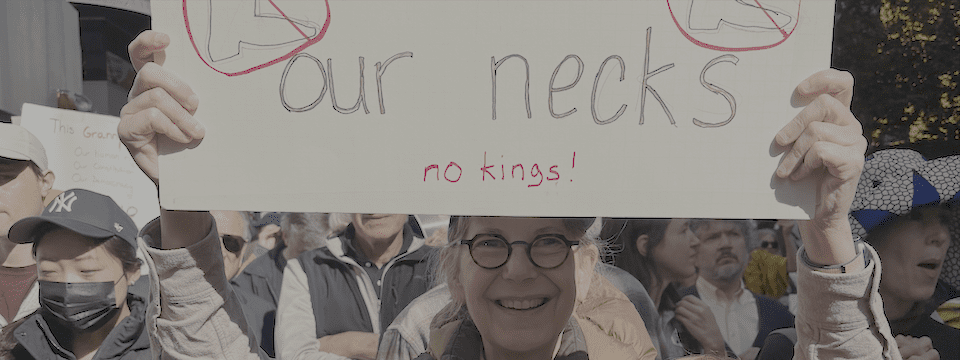
It was a perfect day for a rally, not too hot, not too cold in New York City. Across the country, more than seven million people in 2,500 locations showed up to reclaim our democracy from a right-wing autocrat dedicated to replacing the U.S. Constitution with the authoritarian Project 2025 document. Estimates of turnout in New York City ranged from 150,000 to 400,000 people. We filled Times Square with a crowd that rivaled New Year’s Eve, and it took almost four hours for us to march along the route from West 47th Street and Broadway to West 14th Street and Seventh Avenue. The New York Police Department had very little presence at the march, mostly using their cars to block off anyone who would try to drive into the crowd, and they reported that there were zero incidents of criminality or violence at the main march in Manhattan and other rallies in the five boroughs. Yay us! And thank you to NYPD for keeping us safe.
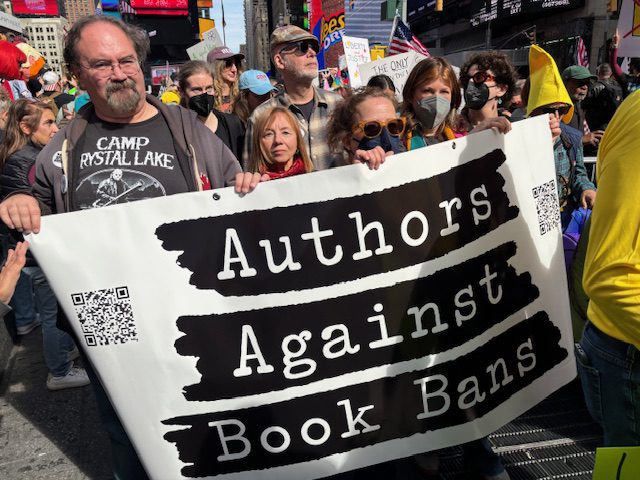
Walter, Genevieve, and I marched alongside a group of about a dozen people with the local chapter of Authors Against Book Bans. We handed out stickers and information to people nearby to let them know about our stand against censorship. Project 2025 has placed a special target on books, libraries, schools, librarians, educators, publishers, and writers. We face strict controls and potential prison terms if Project 2025 is fully implemented and becomes the law of the land.
Freedom of expression and the freedom to read were integral parts of the U.S. where I grew up. Houston, Texas in the 1960s and 1970s was one of the most conservative places in the country, but now-banned books like 1984, Brave New World, and Fahrenheit 451 were assigned reading in my school. My younger brother read Richard Wright’s memoir Black Boy for mandatory summer reading and it opened his eyes to experiences and perspectives he’d never imagined. Granted, this was during the Cold War, and we celebrated and honored our freedoms in contrast to communist tyranny. We had also become aware that the brutal suppression of Black lives and opportunities under Jim Crow had become a central theme of Soviet propaganda; after all, how could the U.S. be the leader of the “free world” while so many of our citizens faced oppression due to the color of their skin?
The fact that the United States could become “a more perfect union” during the civil rights movement and in the years that followed was proof of democracy’s strength in comparison to the totalitarian regimes in eastern Europe and elsewhere. I drew from that belief in creating my character of Štěpán in Torch, who thinks he’ll have the freedom to live his life as a gay man in the U.S., only to have this dream shattered by a World War II resistance fighter who informs him that the Allies were just as homophobic as the Nazis. Still, Štěpán dreams of fleeing Czechoslovakia for the U.S., because he will at least have the freedom to read the books he likes and one day advocate and vote for change.
The regime and its supporters denigrated the No Kings protests because a disproportionate share of the protestors tend to be over 50 years old. I saw many young people in the New York City crowd and think overall that it represented people living in the city who didn’t have work or family responsibilities on a Saturday morning. I did not encourage my son and daughter-in-law to bring their small children to the event, even thought my husband and I did bring our children to protests from a young age. In those days, there was less of a possibility that peaceful protests would meet a violent response from the government, paramilitary groups like the Proud Boys, or lone-wolf extremists.
I also think the over-50 crowd are more likely to attend because we grew up during the Cold War and were shown the differences between life under democracy and life under dictatorship. Many of our parents fought against the Nazis in World War II. We don’t see the U.S. as perfect, but we understand and appreciate the fact that we have the ability to make change through elections, through advocacy to our elected leaders and fellow citizens, and through nonviolent action such as demonstrations, strikes, and boycotts. We also understand that in a democracy we have access to multiple sources of information, including information critical of our government’s policies. The people who waved the American flag at the No Kings march did so out of love for the country where they grew up. It was also to make common cause with those who didn’t come to the rally but who still believe in the idea of America, our history, and our Constitution.
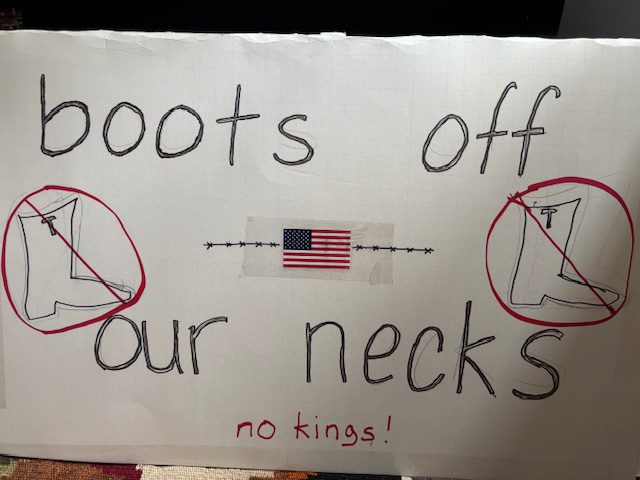
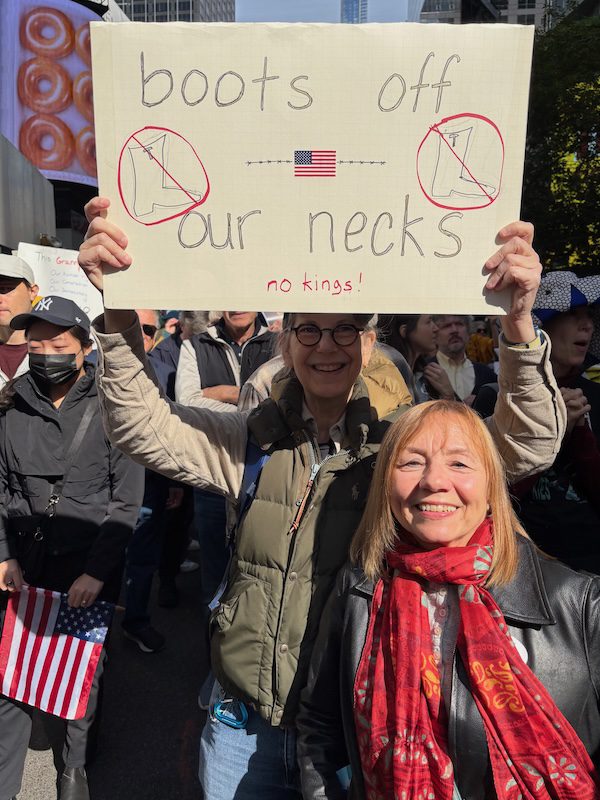
The week before the march, I made a sign that reads “boots off our necks — no kings!” I had ordered some bedding from a company in Georgia, and the box arrived on Thursday with an American flag sticker. Maybe the company wanted to show its patriotism, or else the fact that its products are made in the U.S., but I carefully peeled off the sticker and added it to the sign. (As it started to peel off, I added packing tape.) Based on their location, I doubt the company owners vote the same way I do. But I see my repurposing of their sticker as a way of showing that in the end, we have more in common than we think. This is, above all, the home we share, and we all need freedom to thrive within it.


Pingback: The Price of a Vote | Lyn Miller-Lachmann