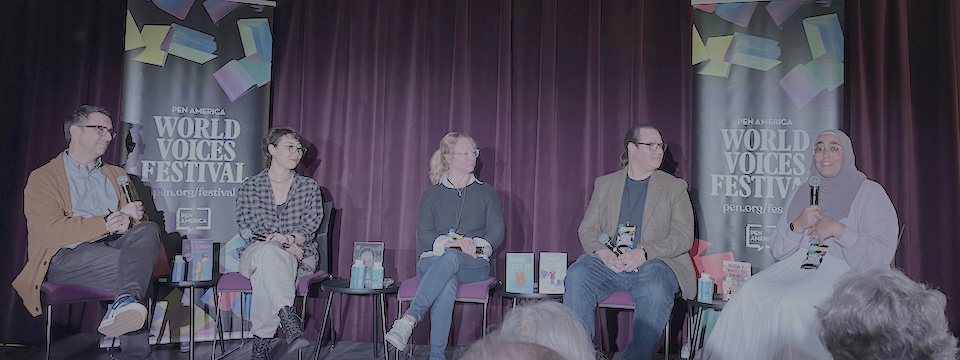
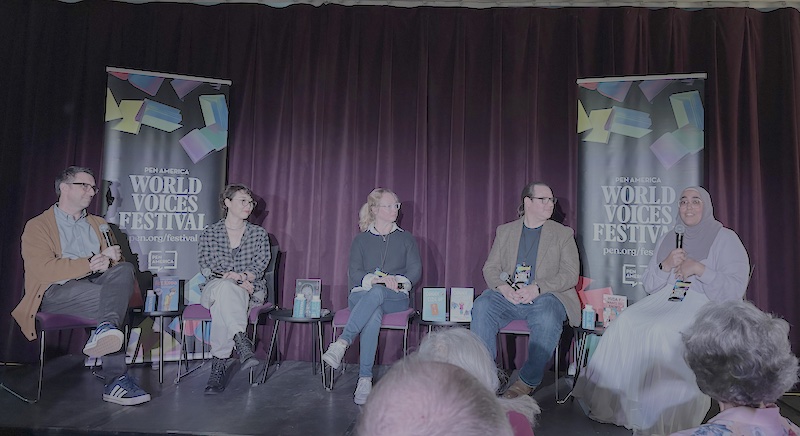
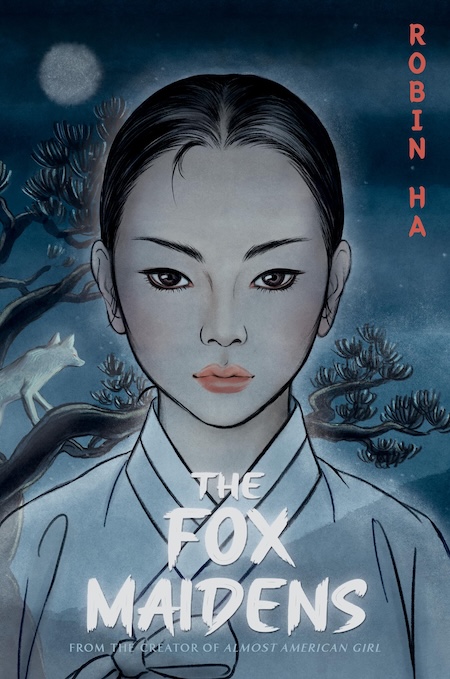
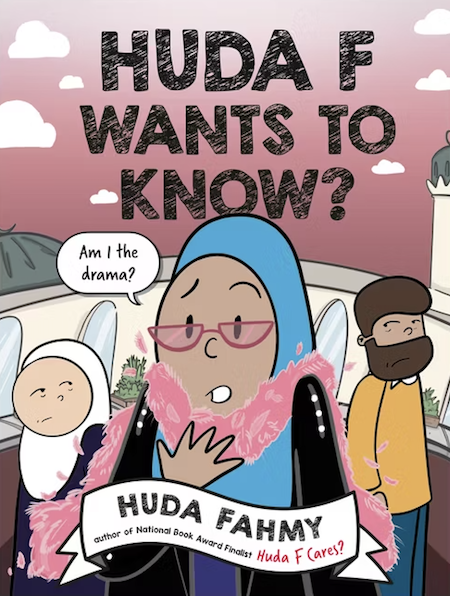
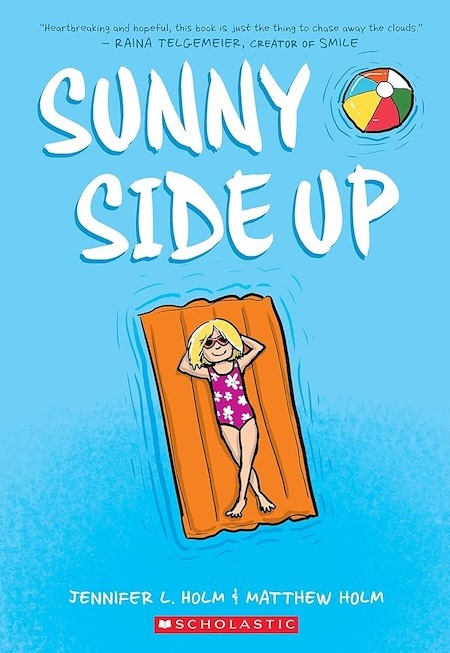
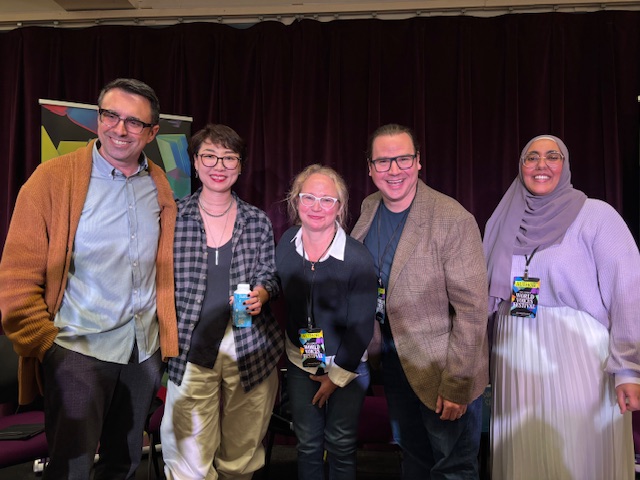
The 2026 PEN World Voices Festival in New York City and Los Angeles included a panel on books for children and teens in New York, and it was both timely and informative. Titled “The Transformative Power of Graphic Novels for Kids,” it featured five leading author/illustrators — Huda Fahmy, Robin Ha, Jennifer L. Holm, Matthew Holm, and moderator/participant Jarrett J. Krosoczka. Panelists introduced their most recent book in an “elevator pitch” style with Jarrett’s animated elevator, complete with soundtrack. Huda’s latest in the Huda F series for teen readers is Huda F Wants to Know?, which portrays the impact of her parents’ divorce on her life and relationships. Robin’s The Fox Maidens is set in medieval Korea and features a warrior’s daughter who bucks tradition while trying to resist an ancient curse. (I reviewed this book for #WorldKidLit Wednesday last year.) The Holm siblings talked about their Sunny series set in the 1970s, which begins with Sunny sent to Florida thinking she’s going to amusement parks but is in fact stuck in a retirement community while her parents deal with a family problem they’re hiding from her. Jarrett talked about his acclaimed 2018 memoir, Hey, Kiddo, and its 2023 follow-up, Sunshine, about his job as a summer camp counselor for children with cancer.
 The first general question to panelists focused on the comics they enjoyed as children. Growing up in Seoul, South Korea, Robin read Korean “girls’ comics” that focused on romance combined with fantasy, horror, and adventure, and she copied their style in her own drawings. The Holm siblings had parents who were avid comic readers, and Matthew, the youngest of five kids, enjoyed all the hand-me-downs from his parents and siblings. He began to draw at the same time as Jennifer, the third child and the only girl, was pursuing a career in film and advertising. She, too, appreciated the comics she read growing up in the 1970s, which she termed “boy comics” (in contrast to the ones Robin read). In those days, the only female protagonist of action comics in the U.S. was Wonder Woman, and Jennifer didn’t identify with her.
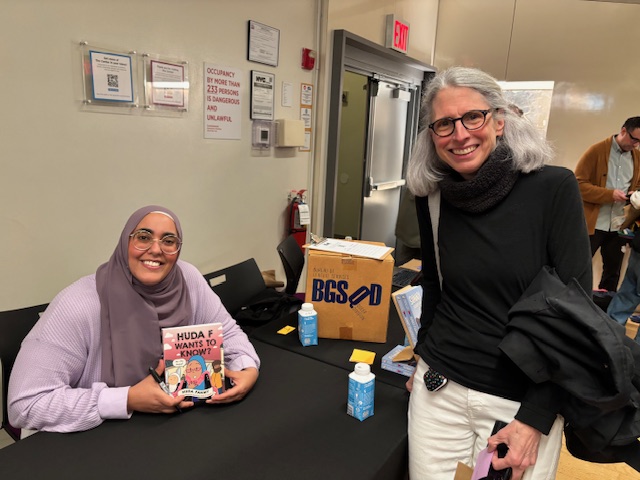
 For Huda, born in Detroit to parents who spoke only Arabic at home, comics helped her learn to read English and to understand the English idioms and sarcasm she didn’t encounter until she started school. She cited Garfield as her biggest influence. Though she liked to doodle in class, her parents discouraged her from a career in the arts, and she became a teacher instead. She started writing again on maternity leave but couldn’t sell any of her manuscripts. Her sister suggested she go back to drawing and to break in through graphic novels. To do so, she had to teach herself to draw. Jarrett was also a fan of Garfield and said that comics helped him get through a difficult childhood marked by his mother’s drug addiction. His grandparents, who raised him, gave him unlimited art supplies, but when it came time for him to choose a career, they, too, encouraged him to be more practical.
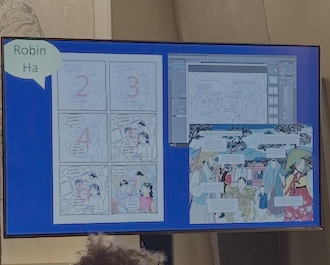
The panelists then spoke about their process, with slides to illustrate. Huda outlines her story first, then writes the script. After that, she draws the panels. She works closely with her art editor and a colorist. Robin writes the entire script first, with thumbnails to follow. She creates her art and layouts digitally. Jennifer and Matthew have a more complicated process because they don’t live near each other. Having worked in film and advertising, Jennifer starts with a storyboard. She then writes the story and sends it to Matthew for his suggestions. She said that it’s much easier to lock down the story first and then produce the artwork rather than having to make time-consuming changes later. Matthew generally produces a range of thumbnails for Jennifer to choose and arrange. Matthew then creates the final art from the thumbnails that Jennifer has chosen. Jarrett said that the idea for his graphic memoirs live in his head for years before he writes them down. He puts his memories on Post-It notes and arranges them on a bulletin board. Jarrett credited his editor David Levithan (also the Holm siblings’ editor) for helping him to go deeper to craft his very personal stories.
 Jennifer added more from her perspective as someone who started out writing prose only — her first book for young readers, the Newbery Honor-winning historical novel Our Only May Amelia, came out in 1999. She has come to appreciate the process of collaboration in her graphic novels with Matthew, saying that in writing prose alone, she was living too much in her head. She encountered writer’s block and came to realize that, as someone who’d worked in film, she envisioned her scenes in images and would benefit from working with her younger brother to turn those images into a graphic novel.
The panel left a good amount of time for audience questions, of which there were many. The first question was “How do you tap into an authentic voice for kids?” Huda said she never fully grew up, and writing helps her work through her experiences as a child and teenager. Jennifer called the Sunny series “a love letter to the 1970s,” the era of her childhood. She remembers the language and shared experiences of the era, such as the fact that in those days “parents and children led parallel lives,” as exemplified by the “children’s table” at family events.
The second question was whether the author/illustrators are traditionally or self- published. Although all of them are traditionally published, both Huda and Robin , the two youngest panelists, started out by putting their comics online because they couldn’t sell their work to agents or editors. Both started to amass a following with a high degree of engagement and were subsequently “discovered.” Huda said she posted a comic every day for 6-7 months until an agent reached out to her. She suggested that aspiring authors of graphic novels take the initiative to do the same. Jennifer and Matthew had fewer obstacles to breaking in as graphic novelists because Jennifer was already established and had an agent. Matthew commented, though, that too many people he meets have been working on the same project for ten years or more, revising after each rejection. He always advises them to put that project aside and start a new one.
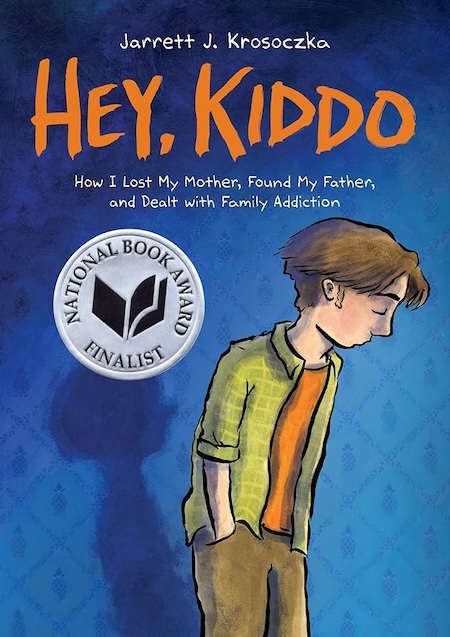 The third question had to do with the difference between a graphic memoir like Hey, Kiddo or Robin Ha’s immigration memoir All-American Girl, and a graphic novel. Robin said that a memoir has to maintain a narrative arc just like a novel does; it can’t be a simple recounting of events. She urged memoirists to think of the work as a story focused on the protagonist’s growth and change. Although Huda’s books are fiction, the stories are based on her family. But fiction allows her to change details and leave out extraneous characters, such as some of her siblings. In fact, one of her siblings is a very private person who asked to be left out of the story, and Huda obliged. Matthew said that novelists can change names and details to fit the story, while memoirists cannot. Jarrett encountered this issue in Hey, Kiddo because of the sensitive nature of his story. He said he didn’t want to make certain people “accidentally famous.” He had the people in the book read the script in advance to check for the veracity of what he remembered. He said that the hardest part wasn’t the real people but rather editing out scenes that were important to him but didn’t fit into the narrative arc. For instant, the summer he spent working at a camp for children with cancer had to be removed from Hey, Kiddo — but it became the heart of Sunshine.
The next question compared graphic novels (and picture books) to movies. Jarrett talked about the magic of the page turn in the graphic novel, which allows both creators and readers to control the pace. Jennifer agreed, and said that her favorite part of working in film was editing, which gives the filmmaker control. Yet in film, the audience does not control the pace. It’s a passive medium. Robin called graphic novels a “superior form” because they’re a happy medium between movies and prose novels. Huda talked about the techniques of film that make their way into graphic novels, such as punch lines connected to page turns, character expressions, dialogue, and sound effects on the page.
The final question had to do with the huge popularity of graphic novels with kids. Jarrett said that if graphic novels existed 30-40 years ago, they would have been hits then. After all, comic books have been popular for a long time. Even so, kids today are inundated with so much more media, and graphic novels reflect the more varied media universe. Robin cited the popularity of manga as an introduction to graphic novels. Matthew noted that readers of graphic novels tend to reread them. The initial read is often quick, with readers going back to appreciate the artwork and to alter the pace. For struggling readers, graphic novels are often the first book they finish, which gives them the confidence to pick up the next book. Huda echoed the accessibility of graphic novels, including for readers who are learning English or who are neurodivergent.
In all, the future is bright for graphic novels. (They’ve certainly won me over!) Jarrett concluded that to be a creator of graphic novels, one needs a lifelong obsession, a love of visuals, a love of cinema, and a love of story.
Lyn, I’m glad you were able to attend the festival. Thank you for this post on the panel. I’m glad graphic novels are doing so well. I remember a time when people disparaged them. Around the time when Gene Luen Yang’s AMERICAN BORN CHINESE won the Printz Award, I started to see more of a shift in perception, with people taking them more seriously.
Thank you for reading and commenting, Linda! For all the people who couldn’t attend the panel, I wanted to share the insights of these wonderful speakers.