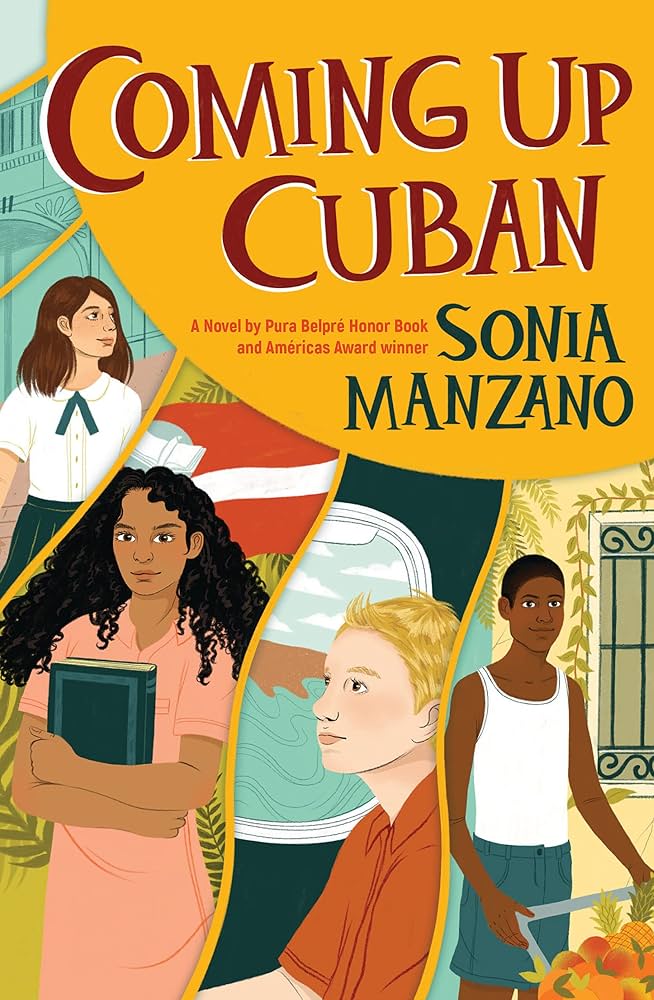
Last month I attended the Bank Street Children’s Book Fest, an annual event that brings teachers and authors together to discuss outstanding books for use in K-12 schools. One of the main presenters was Sonia Manzano, best known as Sesame Street‘s María. She is also the author of numerous award winning books ranging from picture books to young adult. Her novels for older readers, grades five and up, include The Revolution of Evelyn Serrano, set in East Harlem in the late 1960s amid the civil rights activism of the Young Lords, and more recently, Coming Up Cuban, the story of four young people who experience the 1959 revolution in Cuba and its aftermath.
 Shortly after the conference, I found a hardcover copy of Coming Up Cuban that had been left in a book drop. I’ve occasionally found books left behind in random places and dropped off a few myself. It’s said that finding books this way is fated, and it means that the book has come to you at the moment when you need it the most. The first time I found one, for instance, was when I was visiting my father and needed a birthday gift for him. The found book was the latest spy novel by one of his favorite authors.
I had already read and appreciated The Revolution of Evelyn Serrano, so I eagerly snapped this one up and began reading it on the subway ride home. Coming Up Cuban is the story of four Cuban children whose lives are loosely connected to each other, and whose lives change forever because of the revolution. Ana, who is middle class and living in Havana, misses her father, who left to join Fidel Castro’s revolution two years earlier. When he returns with Castro in triumph on New Year’s Day in 1959, she doesn’t recognize him. But while things settle down at home with her father back, disturbing things are happening all over the city — bodies hanging in the park, the explosion of an ice cream truck, school friends fleeing the country. Disturbed by the violence, Ana’s father writes a letter to his friend, Fidel, who responds by having him arrested. After her idealistic father dies in prison, Ana and her mother leave for a cousin’s apartment in New York City. Miguel is the son of friends of Ana’s parents. His family is wealthy, and Ana dislikes him because he is greedy and spoiled. His parents send him out of the country through Operation Pedro Pan, where he endures hardship and bullying in a refugee camp and later in an orphanage. By the time Miguel’s parents are able to escape Cuba and join him, he has learned to work and fend for himself, and his lawn mowing business in Miami that he established with another boy from Operation Pedro Pan will help to pay the family’s rent.
Zulema is a from a rural area. She met Ana when she and her family stayed at Ana’s house in Havana for a victory celebration in summer 1959. Shortly afterward, Castro organizes the Cuban Literacy Campaign, and teenage instructors from the city come to live with Zulema’s family. She is eager to learn, but her father is skeptical, and counterrevolutionaries roaming the area are terrorizing the farmers and turning them against the revolution. Though her education is interrupted, Zulema learns to read, passes the test, and decides to continue her education on her own and become a teacher. Finally, Juan, who sells fruit from a cart with his grandfather — a cart regularly patronized by Ana and her family — follows his best friend into the communist youth group, the Pioneers. The Pioneers’ leader is pressuring the young teenagers to inform on their neighbors, with rewards of food, medicine, and money for every opponent of the regime that they turn in. Juan is torn. His grandfather is sick, but unlike his friend, he doesn’t want to become a snitch. He decides to keep a low profile, focusing on his grandfather’s recovery while dreaming of the day he can escape the country on a raft his neighbor has hidden in the backyard.
 This book resonated with me because it shows what happens when a country has experienced a revolution. And I wonder if the 2024 election, leading to the implementation of Project 2025, was a kind of revolution as well. Certainly not as fast or as violent as the one led by Fidel Castro and Che Guevara. Or even the American Revolution that began with the Declaration of Independence in 1776 and ended with the British surrender in 1983. Like the 1959 Cuban Revolution, the American Revolution led to the emigration of Loyalists to Canada after their property was confiscated and their lives threatened. I have family members in Toronto who trace their ancestors to merchants who fled Boston during the American Revolution because they supported the king.
Next year, people in the U.S. will celebrate the 250th anniversary of the Declaration of Independence. Those who live in our fragile democracy will be treated to televised specials — starting with the excellent Ken Burns documentary now airing on the federally-defunded PBS — and public events. We will have public discussions on the meaning of the American Revolution then and now, discussions that the federal government will probably have little control over unless they intend to empower the kind of neighborhood snitches, the Committees for the Defense of the Revolution, that Fidel Castro implemented. I do hope that those discussions include what happens to the losers of a revolution — those who stood steadfastly against it from the beginning, those who were true believers but then were betrayed, and those whose became disillusioned once they discovered that the revolution’s leaders were violent or dictatorial or only out for themselves.
This essay made me reflect on how revolutions are remembered and who gets written out of the story. Your discussion of disillusionment—both among true believers and those coerced into participation—adds depth to the conversation. It’s a thoughtful reminder that historical anniversaries should invite questioning, not just celebration.