For a writer, the “revise and resubmit” from an agent or editor is the ultimate good news, bad news situation. As more and more overworked publishing professionals move to a “no answer means no” policy, any response counts as encouragement. Even more so when it contains praise for one’s concept, writing, or characters, but ultimately a pass (a kind word for rejection) is a pass. Maybe the next project will garner a more favorable response, but you don’t want to put this project into a drawer. You’ve poured your heart and months or years of your life into it.
A revise and resubmit (R&R) is like a second chance. Not a yes, but if you give the agent or editor the manuscript they have in mind, it will be a yes. Sometimes a R&R letter is quite detailed and specific. More often, it’s frustratingly vague and lacking in direction. For instance, an agent may tell you to cut a third of the words in the last half of the book, as my agent, Jacqui Lipton, did with Torch. (Technically it wasn’t a revise and resubmit but an acceptance with revisions, but I understood that the manuscript would not find an editor unless I removed those 10,000+ words and significantly tightened my ending.) However, I was the one who decided to cut an entire day from a road trip, and I then had to figure out how to include all of the emotional beats in fewer than half the scenes. I also had to cut some of my favorite lines from the manuscript, a traumatic process known as “killing your darlings.”
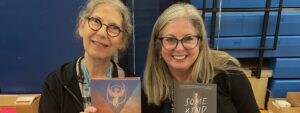
My cutting and tightening was relatively minor compared to what my friend Jilanne Hoffmann faced with her middle grade historical novel in verse set in Iowa during the farm crisis of the 1980s. When she told me about that project, I was immediately hooked. I lived in Madison, Wisconsin in the 1980s and saw the crisis up close — farmers who the government had encouraged to buy new equipment and expand their operations were hit with high interest rates and low demand for their products due to a global economic downturn. Many farmers went bankrupt. Large corporations bought up the distressed farms and consolidated them into factory-like facilities that have worsened conditions for farm animals, workers, and the environment.
 Jilanne’s agent, Lori Steel, is a friend and classmate of mine from VCFA. We had talked about the book before it went out on submission, and when Lori received the R&R, she called me to ask my advice for how to approach the R&R, which urged Jilanne to make her story a contemporary rather than a historical one. The editor thought a contemporary novel would resonate more with middle grade (ages 8-14) readers at a time when middle grade sales are struggling. But that would have involved a complete rewrite, ditching most of what Jilanne had researched and written already. As a fan of historical fiction and a witness to the events at the heart of the story, I suggested an approach that would allow Jilanne to keep much of what she had and to tie it into the experiences of young people growing up in rural areas today — in other words, a dual timeline novel. A few years earlier, I had written a blog post about one of my favorite dual timeline novels, and I gave Lori a list of more recent ones to give to Jilanne: Ellen Oh’s Finding Junie Kim (the one featured in the blog post), Katherine Marsh’s The Lost Year, and Maria van Lieshout’s graphic novel Song of a Blackbird.
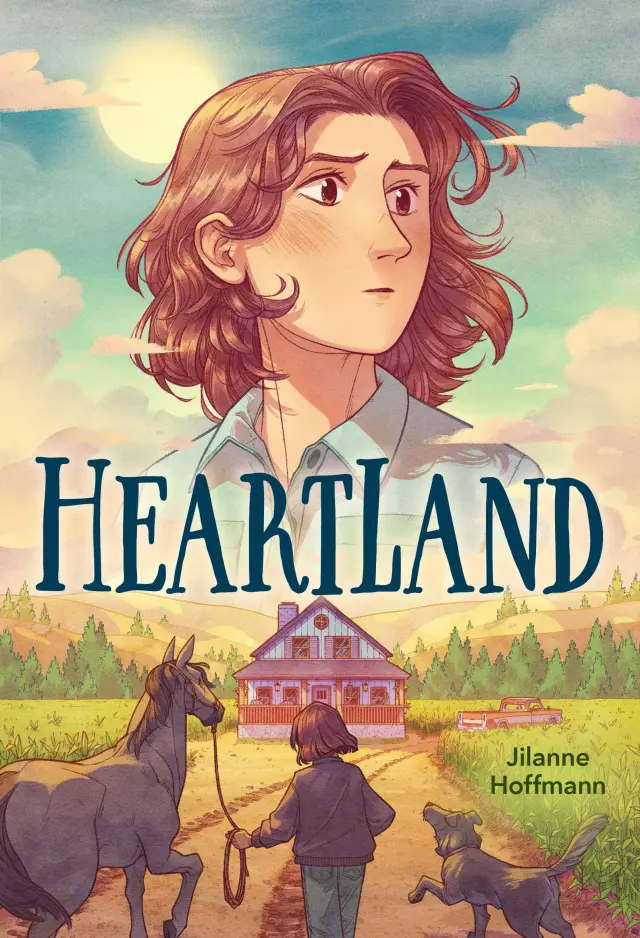
A couple of months ago, Jilanne sent me her just-published middle grade novel HeartLand, the result of her decision to go with the dual timeline revision. The result is brilliant. I can see why the editor accepted it right away, which is far from certain with even the most enthusiastic R&R. This work is truly special, and I am amazed at how Jilanne came up with a story that so compellingly parallels the 1980s farm crisis with today’s factory farms and their impact on their neighbors and the environment.
The dual narrators are a mother, Cassiopeia (Cassie), and her daughter, Xyla. Cassie loves her family’s Century Farm, awarded to farms that have been in the family for a hundred years or more. But the farm is struggling, and many of her classmates and friends are leaving town because their farms have failed. The hospital has closed, which has tragic consequences for her best friend and his family. Cassie loves her horse and her dog, but her dog’s accident leads to one more bill the family can’t pay, and her parents are planning to sell her horse to her worst enemy. Cassie writes poetry, and her chapters are in verse.
Xyla is growing up on the family’s Heritage Farm, which means it has been in the family for 150 years or more, but she doesn’t want to take it over from her single mother, who has turned it into an organic farm that is, if not thriving, at least breaking even. She wonders where her father is, maybe a more exciting place than a half-dead Iowa town where the air stinks from the poop lagoon of a nearby CAFO (Concentrated Animal Feeding Operation). Then a new family moves next door, in the house where Cassie’s grandparents used to live. There’s a girl Xyla’s age, who moved from California after her mother died in the pandemic and her father landed a position as a farm manager. Xyla’s efforts to locate her own missing father lead her to some uncomfortable truths about herself, her mother, and the history of the farm that ties them together.
This generational story portrays life before the technology that gets Xyla into so much trouble, although readers see that kids 40 years ago had no shortage of ways to get themselves into trouble as well. Having both eras in the dual timeline enriches the story and offers important perspectives on a different kind of farm crisis today, one caused by climate change as well as the economic changes that began decades ago.
For writers apprehensive about the R&R, I hope Jilanne’s experience with HeartLand serves as inspiration. Whether or not you’re interested in the subject, the book is worth reading to see how she took the feedback and ran with it. Having read the final version, I see the R&R as an opportunity, an agent or editor telling you that you have something great already, but with some more thinking and writing, you can turn it into something amazing. Something you’ll always be proud of, and something your readers will remember long after they’ve turned the final page.